 how-to
Scaffolding Safety on Heritage Sites: A Guide
Table of Contents
- Why Scaffolding Safety on Heritage Sites Differs from Standard Projects
- Understanding Scaffold Risk Assessment for Historic Buildings
- Protecting Historic Masonry: Scaffold Ties for Historic Buildings
- Regular Scaffolding Inspections on Heritage Properties
- Scaffolding Public Protection at Heritage Sites
- Heritage Consent and Scaffold Design Planning
- Fall Prevention and Safe Access on Period Buildings
- Common Mistakes That Damage Historic Buildings
- Frequently Asked Questions
Last Updated: October 10, 2026
Why Scaffolding Safety on Heritage Sites Differs from Standard Projects
Scaffolding safety on heritage sites requires a fundamentally different approach than modern buildings. Historic structures present unique challenges: the stonework, timber frames, and architectural details that make these buildings valuable are fragile and easily damaged by conventional scaffolding methods.
The difference comes down to planning. A standard project prioritizes speed and cost; a heritage project must prioritize protection of the building fabric alongside worker safety, requiring custom design, specialist materials, and ongoing monitoring.
The stakes are higher on heritage sites. Damage to period masonry cannot be reversed, a poorly positioned tie can hole 300-year-old stonework, and water ingress can damage internal timber structures permanently.
This is where scaffolding safety on heritage sites becomes a conservation issue, not just a safety issue. You need a team that understands both the regulations and the building itself.
Understanding Scaffold Risk Assessment for Historic Buildings
Risk assessment for historic buildings must address hazards beyond standard forms: fall risks, load limits, and weather exposure, plus the building's structural capacity to accept scaffold loads, masonry condition, and hidden voids or weaknesses.
A competent person must examine the building's construction history: Is it solid masonry or cavity wall? Are there timber lintels that might fail under concentrated loads? Has the building settled unevenly? These questions determine safe tie attachment points.
Many heritage buildings have been altered over centuries, rebuilt, patched, and repointed at different times. Each section has different structural capacity. A risk assessment treating the whole facade as uniform will miss critical weak points.
The assessment must consider how scaffolding affects building users and the public. On occupied sites, disruption creates additional risks. Weather protection is critical because tarping can trap moisture, potentially damaging the building.
| Assessment Focus | Standard Building | Heritage Building |
|---|---|---|
| Fall prevention | Yes | Yes |
| Load capacity | Building code minimum | Varies by wall age and condition |
| Tie point strength | Uniform | Highly variable |
| Weather protection | Temporary | Must prevent water ingress and damage |
| Public safety | Standard barriers | Consider visual impact and access |
Protecting Historic Masonry: Scaffold Ties for Historic Buildings
Scaffold ties are the physical connection between temporary access and the building. On modern structures, standard bolted ties are acceptable. On heritage buildings, this destroys irreplaceable material. You need scaffold ties for historic buildings that distribute load without permanent damage.
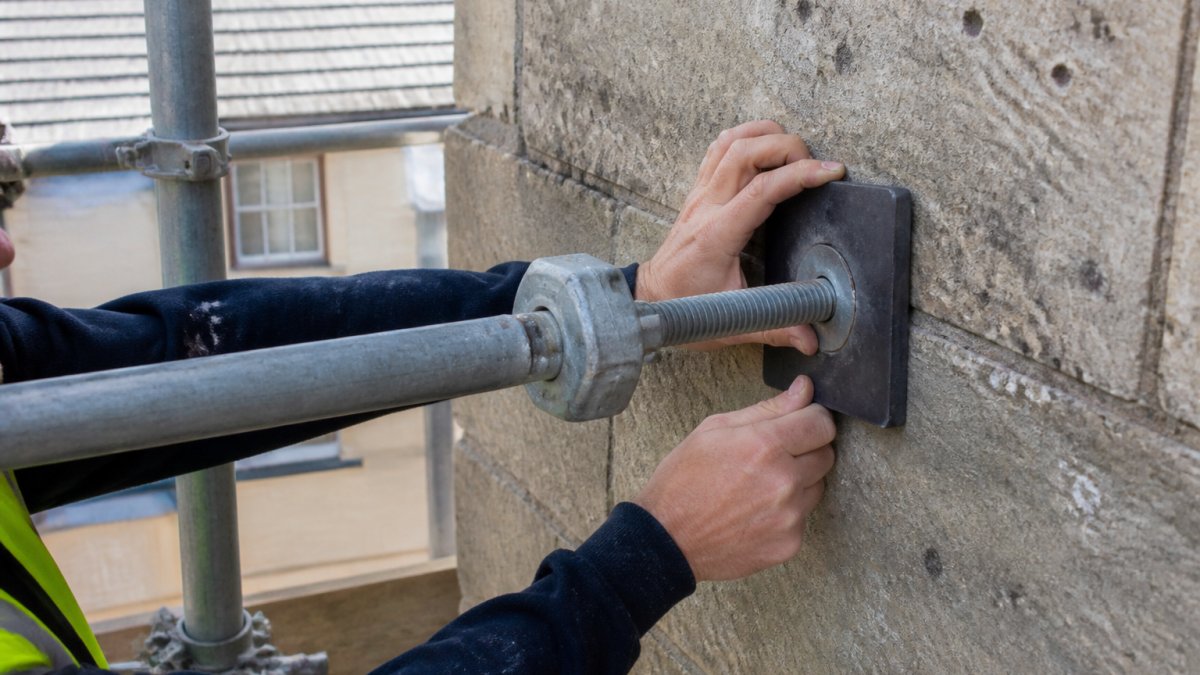
Fixing Ties Without Damaging Period Stonework
The goal is to create a temporary connection that leaves no trace. This means avoiding bolt holes, mortar damage, and stress fractures in the stonework. Several methods work:
- Adjustable acrow props with rubber pads: These distribute load across a wider surface area rather than concentrating it at a single point. The rubber pad protects the stone from direct contact with metal.
- Padded needle ties: A horizontal member passes through the scaffold and rests on protective pads positioned in mortar joints. The tie is removed and the joint repointed after dismantling.
- Magnetic tie systems: For iron or steel-framed structures, magnetic connections avoid drilling altogether.
- Temporary corbel brackets: Bolted only to mortar joints rather than the stone itself, allowing clean removal and repointing.
Each method requires precise positioning. A tie in weak mortar will fail; a tie in sound stone will damage it. The competent person must inspect mortar and stone condition before fixing ties.
Conservation-Compatible Materials and Methods
The materials used for scaffold ties matter as much as the method. Standard mild steel ties can stain light-coloured stone and corrode if not protected. On heritage buildings, consider:
- Stainless steel ties and pads: Resist corrosion and won't stain delicate masonry.
- Rubber and neoprene protection pads: Prevent direct contact between metal and stone.
- Temporary mortar: Softer mortar used for tie fixing ensures that when ties are removed, the temporary mortar fails first, protecting the original masonry.
- Lime-based repointing: After ties are removed, repointing with lime mortar that matches the original specification ensures the repair is reversible and compatible with the historic fabric.
These materials cost more than standard supplies but prevent damage that would cost thousands to repair or cannot be repaired at all.
Regular Scaffolding Inspections on Heritage Properties
Inspections follow the same legal schedule as any scaffold: weekly for working scaffolds, monthly for static structures. But the checklist must expand to monitor the building's condition alongside scaffold safety.
Standard weekly inspections check scaffold integrity: connections, visible damage, stability. On heritage sites, also check for signs of building damage: mortar dust around ties, hairline cracks in masonry, or water seepage where weather protection may be failing.
What to Check During Weekly and Monthly Inspections
Weekly inspections should include:
- All standard scaffold safety checks (connections, bracing, platforms)
- Condition of protective pads and rubber buffers
- Signs of mortar erosion around tie points
- Weather protection integrity (tarps, screens, guttering)
- Debris accumulation that could block drainage or damage the building
- Any visible movement or settlement of the scaffold
Monthly inspections add deeper assessment:
- Full visual inspection of all tie points for damage or mortar loss
- Assessment of weather protection effectiveness
- Check for water ingress or dampness in areas adjacent to the scaffold
- Photographic record of tie point condition for comparison over time
- Review of any settlement or movement patterns
Document everything. Photographs taken at the start of the project, during weekly inspections, and at project completion create a record that protects both the building and the contractor.
Monitoring Movement and Vibration on Historic Structures
Historic buildings are often more sensitive to vibration and movement than modern ones. Timber frames flex and settle; masonry cracks under stress. Excessive vibration or building movement under scaffold loads requires immediate attention.
Simple monitoring methods include crack monitoring tape (breaks if cracks widen), plumb bob checks (shows tilting), laser levels (detects uneven settlement), and vibration observation. More sophisticated electronic monitoring is available for complex projects or exceptional heritage value.
Scaffolding Public Protection at Heritage Sites
Heritage sites are often in town centres or busy streets. Barriers must prevent scaffold access while maintaining pedestrian flow and preserving visual character.
Standard metal barriers are visually jarring on historic streets. Many conservation areas require temporary hoardings that screen the scaffold while allowing partial views. This protects the public, the scaffold, and reduces the perception of abandonment.
Free, no-obligation quotations →
Clear, professional signage explaining the work and expected duration reassures the public and business owners. On occupied sites, communicate the timeline to tenants and customers.
Heritage Consent and Scaffold Design Planning
Scaffolding on listed buildings and within conservation areas requires formal heritage consent before work begins. This is a separate approval from building control and is mandatory under the Planning (Listed Buildings and Conservation Areas) Act 1990. Failure to obtain consent can result in enforcement action, fines up to £20,000, and requirement to dismantle and rebuild the scaffold to an approved design.
Listed Building Consent and Conservation Area Notification
If your site is a listed building, you must apply for Listed Building Consent (LBC).
The conservation officer assesses whether the proposal harms the character or appearance of the listed building. This assessment focuses on visual impact (will scaffold dominate street views?), damage risk (are tie points positioned to avoid decorative stonework and windows?), reversibility (will removal leave the building in original condition?), and archaeological constraints (might tie points disturb buried remains?).
Processing time for LBC is typically 8-12 weeks, but applications lacking detail or raising conservation concerns often require revision, extending to 16-20 weeks. Early engagement with the conservation officer before formal application can identify concerns and reduce revision risk.
Conservation Officer Consultation and Design Approval
Pre-application consultation with the conservation officer allows you to present your scaffold concept, receive feedback on tie points and materials, and understand priorities before detailed design. Discuss tie point strategy, material choices (stainless steel ties, neoprene pads, lime-based mortar), weather protection (breathable membranes preferred over full tarping), hoardings and visual screening, and removal/reinstatement processes. Document consultation in writing to protect against later challenges.
Archaeological and Structural Constraints
For buildings with archaeological interest or complex structural history, additional assessments may be required. Archaeological desk-based assessment identifies whether ground works or tie points could disturb buried remains. Structural engineer's assessment confirms the scaffold can be safely attached without overstressing the building, specifying maximum tie loads, recommended spacing, and location restrictions.
These assessments add 4-6 weeks to the planning phase but prevent costly redesigns and protect the building from damage.
Timescale and Budget Planning
Allocate 16 weeks from initial concept to consent decision: weeks 1-2 pre-application consultation, weeks 3-4 design refinement, weeks 5-6 formal application, weeks 7-14 authority assessment (8 weeks standard, extending if revisions required), week 15+ consent decision. Start the heritage consent process before confirming the contract. Failure to allow adequate time is a common cause of project delays and illegal pressure to erect scaffolding before consent.
Fall Prevention and Safe Access on Period Buildings
Fall prevention on heritage sites follows standard regulations but must work within the building's constraints. Period buildings often have irregular facades, protruding features, or fragile decorative elements that complicate standard fall arrest systems.
Guardrails and toe boards must be positioned carefully to avoid damaging architectural details. Stairways and ladders must fit within confined spaces. Edge protection cannot damage stonework. These constraints require custom solutions rather than off-the-shelf components.
Safe access also means considering how workers will reach the scaffold. Narrow streets, parked cars, and pedestrian traffic in heritage areas make delivery and erection more complex. Plan access routes carefully and coordinate with local authorities if street closures or traffic management are needed.
Common Mistakes That Damage Historic Buildings
The most damaging mistake is treating a heritage project like a standard one.
Another common error is underestimating the time needed for planning and consent. Teams that rush the design phase to save money often end up rebuilding the scaffold after conservation officers reject the initial design. Start planning early.
Poor communication with building owners and occupants creates additional problems. If the owner doesn't understand what the scaffold will do or how long it will take, they become frustrated and may pressure the team to cut corners on heritage protection.
Finally, many teams fail to document the work. Photographs and inspection records prove that the scaffold was properly designed, installed, and maintained. Without this documentation, any damage to the building becomes a liability dispute.
Scaffolding safety on heritage sites is complex work that demands expertise most general contractors don't have. The regulations are the same, but the execution is entirely different.
Frequently Asked Questions
What makes scaffolding safety on heritage sites different from standard construction projects?
Heritage buildings require additional safeguards beyond standard scaffolding safety. Historic masonry is often softer and more fragile than modern materials, making it vulnerable to damage from tie points and vibration. You must also comply with heritage consent requirements, protect original architectural features, and account for irregular or weakened structures. A full scaffold risk assessment must evaluate both worker safety and building protection, requiring specialist knowledge of period construction methods and conservation principles.
How should scaffold ties be fixed without damaging a historic building?
Scaffold ties for historic buildings must use protective measures such as rubber or plastic pads to distribute load and prevent direct contact with masonry. Ties should be positioned at mortar joints rather than through stone blocks where possible. Low-impact fixing methods like padded clamps or spreader plates reduce stress on period materials. A competent surveyor should approve tie locations before installation. Regular inspection ensures ties don't embed into soft stone or cause water ingress, which can lead to frost damage or decay.
What should a heritage scaffolding inspection checklist include?
Scaffolding inspections on heritage sites must cover standard safety checks: guardrails, toe boards, platform condition, and tie security. Add heritage-specific items: evidence of water penetration around tie points, cracks or movement in historic masonry, vibration effects on adjacent structures, and condition of protective pads. Check that ties haven't embedded into soft stone and that mortar joints remain intact. Document findings with photographs. If movement or damage is detected, stop work and obtain specialist advice before continuing.
What public safety measures are required around scaffolding on a heritage site?
Scaffolding public protection at heritage sites must prevent pedestrians and vehicles from entering exclusion zones. Install warning signs, barriers, and safety netting where required. On occupied high streets or town centres, minimize frontage coverage and maintain pedestrian access where safe. Falling-object protection (debris netting or toe boards) is mandatory, especially on buildings above public areas. Ensure safe egress routes remain clear and that emergency access is maintained. Local planning or conservation teams may impose additional requirements for occupied heritage sites.